Warriors Raise Their Voices—and Spirits—at Camp Wanwɔd
Singing, games, and reflections on community complemented lessons on type 1 diabetes and sickle cell disease at the recent weeklong PEN-Plus integrated camp in Sierra Leone.
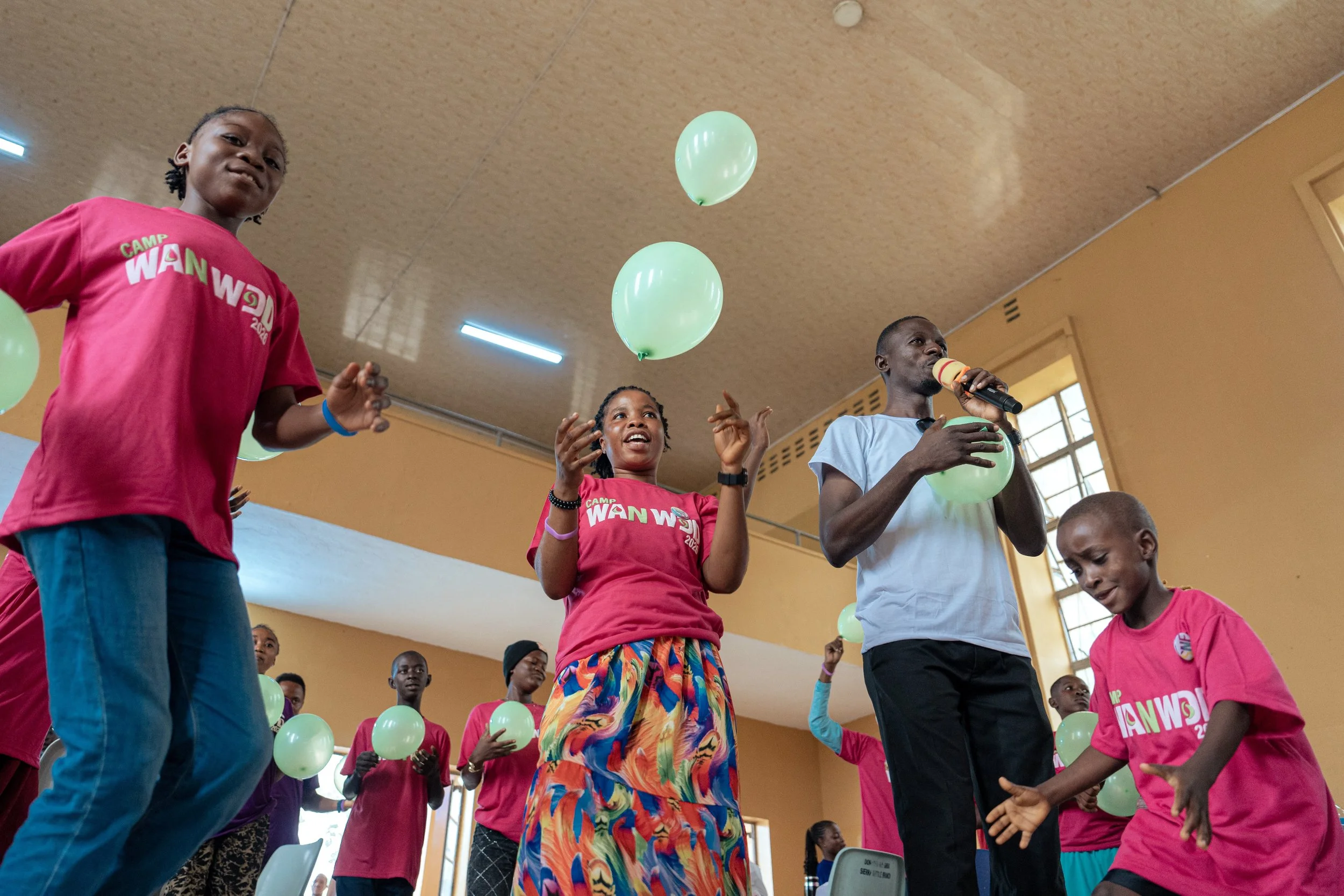
Camp Wanwɔd featured music therapy from the Music Heals Initiative Sierra Leone, which led music-based activities throughout the week, including sing-a-longs, games, and a balloon-filled morning-energizer activity. (Photo: Federico Bruckner)
During the weeklong Camp Wanwɔd in Bo, Sierra Leone, young campers and adult staff were asked to describe the camp in one word.
It was a fitting exercise, because in the widely shared Krio language, Wanwɔd means “unity,” “agreement,” or, literally, speaking together with one word. For a camp that brought together more than 60 young people living with either type 1 diabetes or sickle cell disease to share experiences and peer support during a week of health education and empowerment, Wanwɔd—pronounced wahn-wawd—was an apt name.
But as it turns out, there was far more than one word to describe Camp Wanwɔd.
“It’s love,” said Becky Praise Omakor, an 18-year-old who lives with sickle cell and is from the city of Bo.
“Joy,” said Osman Sesay, a 17-year-old with type 1 diabetes who receives care at Pujehun District Hospital’s PEN-Plus clinic, one of two clinics serving young people who attended the camp.
“Success,” said Emmanuel Fofanah, a community health officer for Partners In Health–Sierra Leone, which administers health facilities across the country.
All those responses reflected the vibes at the camp, which was organized by the NCDI Poverty Network in partnership with Doctors with Africa CUAMM, an international nongovernmental organization committed to health promotion; Partners In Health–Sierra Leone; and the Sonia Nabeta Foundation, whose programming includes organizing camps for young people living with type 1 diabetes. CUAMM operates the PEN-Plus clinic in Pujehun, while Partners In Health–Sierra Leone manages the country’s other PEN-Plus clinic, at Koidu Government Hospital in Kono District.
Camp Wanwɔd also featured music therapy from the Music Heals Initiative Sierra Leone, which had a band on stage in the main hall throughout the week and led several sing-a-longs and music-based activities.
That suggests another fitting word for the camp: Loud.
But the campers, who refer to themselves and each other as “warriors” because of the health and social challenges they face daily, said the noise was not a problem.
“I had a lot of fun, especially with the music,” said Mariatu Kamara, a 22-year-old type 1 diabetes warrior who lives in Bo. “I love to sing.”
Kamara sang several times in front of the entire camp, taking the mic in the main hall at Bo Secondary School, a historic local boarding school where the camp was held. She said one of her favorite parts of the camp was learning from other warriors, particularly those living with sickle cell.
“I’m so happy to meet my colleagues, because they are going through a lot,” Kamara said. “I think the sickle cell warriors, they are very strong. They are continuing to take their medication every day. I appreciate them because they are strong warriors.”
Bringing together young people with different conditions—to learn from and support each other in a camp setting that illuminates their common experiences—is the intentional foundation of PEN-Plus camps such as Wanwɔd. The camp setup reflects the PEN-Plus model of integrated care, which trains clinicians in low-resource settings to provide care in one place for a range of severe, chronic noncommunicable diseases.
Because young people with such conditions often face social stigma in their schools and communities, along with a lack of awareness about their condition, camps like Wanwɔd provide a space for care beyond a clinical setting. Warriors build confidence, learn about their condition and how to manage it, and realize they are not alone.
And every day, they learn about people living with other challenging conditions.
“Coming to this camp has taught me a lot, and it has made me know a lot of people with type 1 diabetes,” said Fea Fomba, 24, a sickle cell warrior and the lead sickle cell counselor at the camp. “I know now that they are my people. We are all the same—because we share the same challenges. We all experience the stigma and having people look down on us.”
Held Aug. 3–7, Camp Wanwɔd was the first of three PEN-Plus camps that took place across sub-Saharan Africa in August. The following week saw the Centre for Infectious Disease Research in Zambia host the second annual Camp Tuli Bonse near Lusaka for type 1 and sickle cell disease warriors. Then, from Aug. 17 to 21, SolidarMed Zimbabwe held Camp Mukundi, which hosted young warriors with heart disease, in addition to warriors with type 1 diabetes and sickle cell disease.
Camps like Wanwɔd will continue to grow. In August, the Bukhman Foundation announced a three-year partnership with the Center for Integration Science in Global Health Equity, the Network’s administrative home, to support the expansion and evaluation of PEN-Plus camps. Camp Wanwɔd was the first camp to be funded by the foundation, which provided support through Mass General Brigham.
The promise of future camps is good news for warriors such as Mohamed Tejan, a 19-year-old living with sickle cell disease in Freetown, Sierra Leone’s capital. Every two or three months, he travels several hours from Freetown to the Pujehun PEN-Plus clinic for medicine and care.
He responded to the one-word question about Camp Wanwɔd with a full sentence.
“We should do it again,” he said.