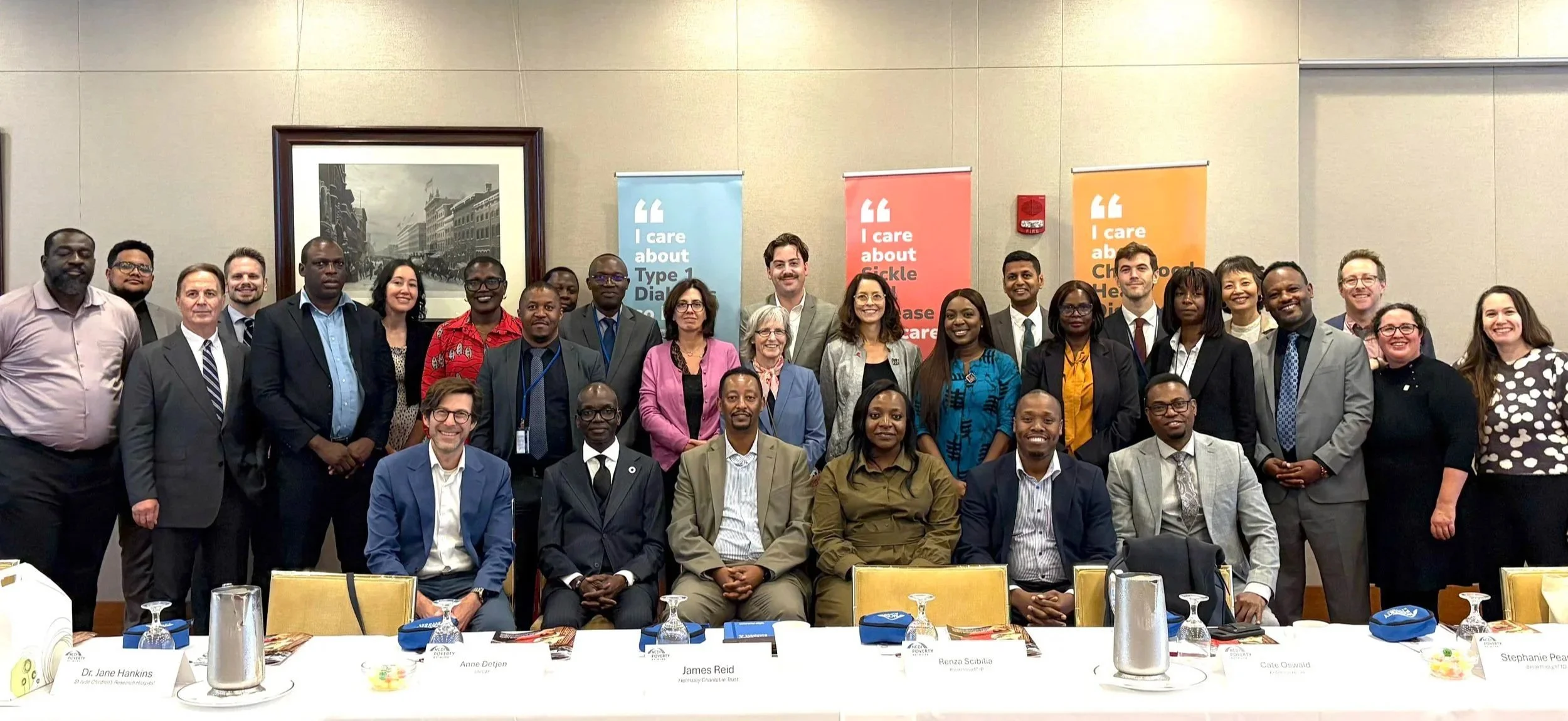
Members of the NCDI Poverty Network’s High-Level Advisory Group met on September 22 in New York City during United Nations General Assembly Week 2026.
When the United Nations General Assembly gathered in September 2025, it held a High-Level Meeting on Prevention and Control of Noncommunicable Diseases and Promotion of Mental Health. In the year between that meeting and the General Assembly this September, bold new partnerships and program launches have made it a momentous time for care for severe, chronic noncommunicable diseases (NCDs).
That progress came despite a tumultuous year for global health financing, and in a period that some might have expected to be quiet, between last year’s meeting and the High-Level Meeting on Universal Health Coverage, set for next September. Instead, the year brought new investments in NCD care, with the PEN-Plus model of integrated care at the center of planning, training, and implementation.
Rachel Gasana, senior director of advancement for both the Center for Integration Science in Global Health Equity and the NCDI Poverty Network, said that partnerships over the past year are creating an inflection point for integrated care and PEN-Plus.
“This has been a positive accelerator of many longstanding relationships and work that has been going on for quite some time,” Gasana said. “For partnerships and programs to succeed, you need a supporting ecosystem. You need to have political will and investment, and you must have laid significant collaborative groundwork. That’s really what the NCDI Poverty Network has strived to build.”
New Partnerships
As that ecosystem has matured, more partners have begun building on it.
In November 2025, for example, while the political declaration from the High-Level Meeting was still under debate, a coalition of partners launched the Alliance for Integrated, Government-led Networks for T1D (ALIGN-T1D). The alliance brings together global funders of type 1 diabetes programs, leading producers of diabetes medicines and technologies, and members of the global type 1 diabetes community.
Breakthrough T1D and The Leona M. and Harry B. Helmsley Charitable Trust, together with Roche and Sanofi’s Global Health Unit, hosted the launch on Nov. 14, World Diabetes Day.
“Investing in collaborative efforts, like ALIGN-T1D, helps create a world where all people living with T1D can thrive,” Dr. Gina Agiostratidou, director of the Type 1 Diabetes Program at The Helmsley Charitable Trust, said at the launch. “With many competing priorities in global health, we can do so much more when we act together. Collective action across sectors is key to ensuring the diabetes community’s priorities are included in country health policies and systems.”
In May 2026, another collaboration—this time between Eli Lilly and Company and UNICEF USA—gave a significant boost to NCD prevention and care for children. With a $50 million commitment from Lilly, UNICEF is expanding its efforts to strengthen primary healthcare systems to better prevent, detect, and manage NCDs, including through its ongoing support of PEN-Plus programs.
In June, more than 1,000 delegates gathered in Dar es Salaam, Tanzania, for the Third International Conference on PEN-Plus in Africa. That was up from 400 at the inaugural conference, in 2024. Cabinet-level ministers from eight sub-Saharan African countries also attended.
The 2026 UN General Assembly continued that momentum. At a side event on September 23, for example, partners launched OneSCD, a global partnership to mobilize support for country-led efforts to expand newborn screening, strengthen health systems, and scale up comprehensive care for sickle cell disease. Hosts included the government of Nigeria, UNICEF, the World Health Organization, Africa CDC, the World Coalition on Sickle Cell Disease, and St. Jude Children’s Research Hospital.
Countries Take the Lead
National governments in low- and lower-middle-income countries have also found new ways forward.
“It’s been heartening to see how country leadership and national health officials are not throwing their hands up in despair around a changing financial landscape,” Gasana said. “Instead, they are saying, ‘Okay, how are we going to figure this out?’”
National operational plans for PEN-Plus have been central to that work. Health leaders and care providers in several countries say the plans have cemented government commitment and secured funding and other resources. They have also helped PEN-Plus grow from local pilot projects into national programs embedded in health systems and strategic planning.
Kenya, Zambia, and Zimbabwe all launched national PEN-Plus plans in 2025, and Ethiopia followed in January 2026. Other national plans are in development, including those for Liberia, Mozambique, Sierra Leone, Tanzania, and Uganda.
A recent meeting of the NCDI Poverty Network’s High-Level Advisory Group highlighted the leadership of several of those countries. Held during this year’s United National General Assembly Week, the event featured a panel discussion with three country-level health experts: Dr. Dereje Duguma, Ethiopia’s state minister for health services and programs; Dr. Ouma Oluga, principal secretary of the State Department for Medical Services in Kenya; and Dr. Henry Phiri, assistant director of disease control and prevention in Zambia’s Ministry of Health.
Looking Ahead
A year ago, the Network’s position statement for the High-Level Meeting on NCDs set out three priorities. The first was closing the deadly gap in the global agenda for children, adolescents, and young adults living with severe NCDs in low- and lower-middle-income countries. The second was pursuing integrated care models, while the third was creating targeted financing mechanisms.
With next year’s High-Level Meeting on Universal Health Coverage approaching, those priorities—and the messages and partnerships built around them—are shaping what comes next.
“These messages really give a handhold for country leaders to be able to advance the political will and financial commitment to work toward national scale-up of the PEN-Plus model, integrated care for NCDs, and stronger health systems,” Gasana said. “That’s a critical indicator that the Network we’ve built and the multisector approach we’ve taken are working and facilitating positive change.”