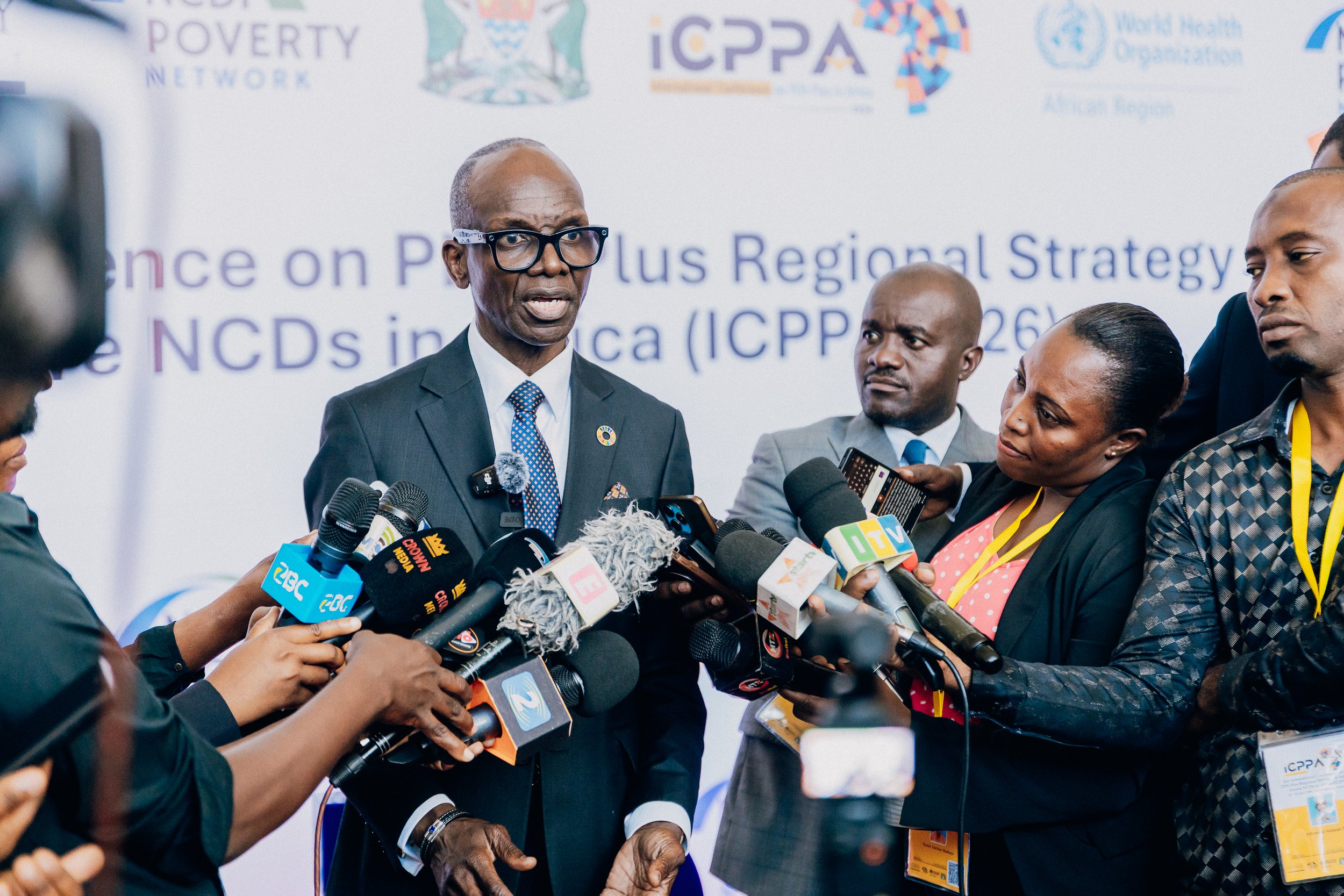
Dr. Mohamed Janabi, regional director for the WHO Regional Office for Africa, speaks to members of the media following the opening ceremony of the Third International Conference on PEN-Plus in Africa. (Photo: Courtesy of the World Health Organization)
Media coverage and social media reactions to the Third International Conference on PEN-Plus in Africa, or ICPPA 2026, highlighted the growing momentum of PEN-Plus and integrated care for severe, chronic noncommunicable diseases, with particular focus on young children living with NCDs and the national leaders working to strengthen health systems.
“ICPPA 2026 confirmed that we are now beyond demonstrating that PEN-Plus is feasible. We know what works and how to do it,” Dr. Benido Impouma, director of the WHO Regional Office for Africa’s Health Promotion, Disease Prevention and Control Cluster, recently wrote on social media. “What is needed now is political commitment at the highest level, sustainable financing, and the health system capacity.”
The Honorable Mohamed Mchengerwa, Tanzania’s Minister of Health, emphasized in remarks on the conference’s opening day that Tanzania is demonstrating that commitment.
“Tanzania has increased significant investment in the health sector by improving infrastructure, medical equipment and access to essential medicines, as well as increasing the budget for noncommunicable diseases from 7 percent in 2020 to more than 24 percent in 2024,” Mchengerwa said, as reported by the Tanzania Daily News.
Mchengerwa’s remarks also included how the PEN-Plus model of care brings specialized services closer to people in rural areas through district hospitals and health centers, reducing distance, costs, and preventable deaths, according to the Daily News.
James Reid, type 1 diabetes program officer for The Leona M. and Harry B. Helmsley Charitable Trust, wrote on social media that Mchengerwa’s and other health leaders’ remarks stood out at the conference in Dar es Salaam, Tanzania, because they demonstrated “how much momentum has been gained as African governments double down on country-led, integrated primary healthcare. Beyond filling urgent gaps in care for type 1 diabetes, sickle cell, and childhood heart conditions, speakers called out how the PEN-Plus service delivery package can build on existing efforts to strengthen the overall health system.”
A lead organizer of ICPPA 2026 also noted that the impacts and momentum for PEN-Plus—which in the past six years has expanded to more than 20 countries across sub-Saharan Africa—drew the attention of national leaders at this year’s conference.
Dr. George Msengi, executive director of Tanzania Impact for Health and the PEN-Plus national liaison coordinator for Tanzania’s National Institute for Medical Research, said the participation of numerous heads of state, delegates from more than dozens of countries, and more than a thousand in-person participants set the stage for action on NCDs. “We exchanged extensive experiences, networked, and built on best practices to broaden the access to care for severe NCDs in Africa,” Dr. Msengi wrote, listing type 1 diabetes, sickle cell disease, and heart disease as key focus areas. “We leave with a regional operational plan, fostered collaborations, and a zeal to change the trajectory of NCDs in Africa.”
ICPPA 2026 drew attention from outside of Africa, as well. Abhilasha Gurung, health specialist for UNICEF in Nepal—a country that is implementing PEN-Plus as part of a growing movement in South Asia—said that for her, this year’s focus on children living with severe NCDs was especially powerful.
“The tragedy is not that these diseases exist; the tragedy is that children living with NCDs remain invisible,” Gurung said. “Their stories are missing from policies, funding priorities, and public conversations because those most affected often have no voice. At ICPPA 2026 in Tanzania, I joined a global community committed to changing this narrative.”