
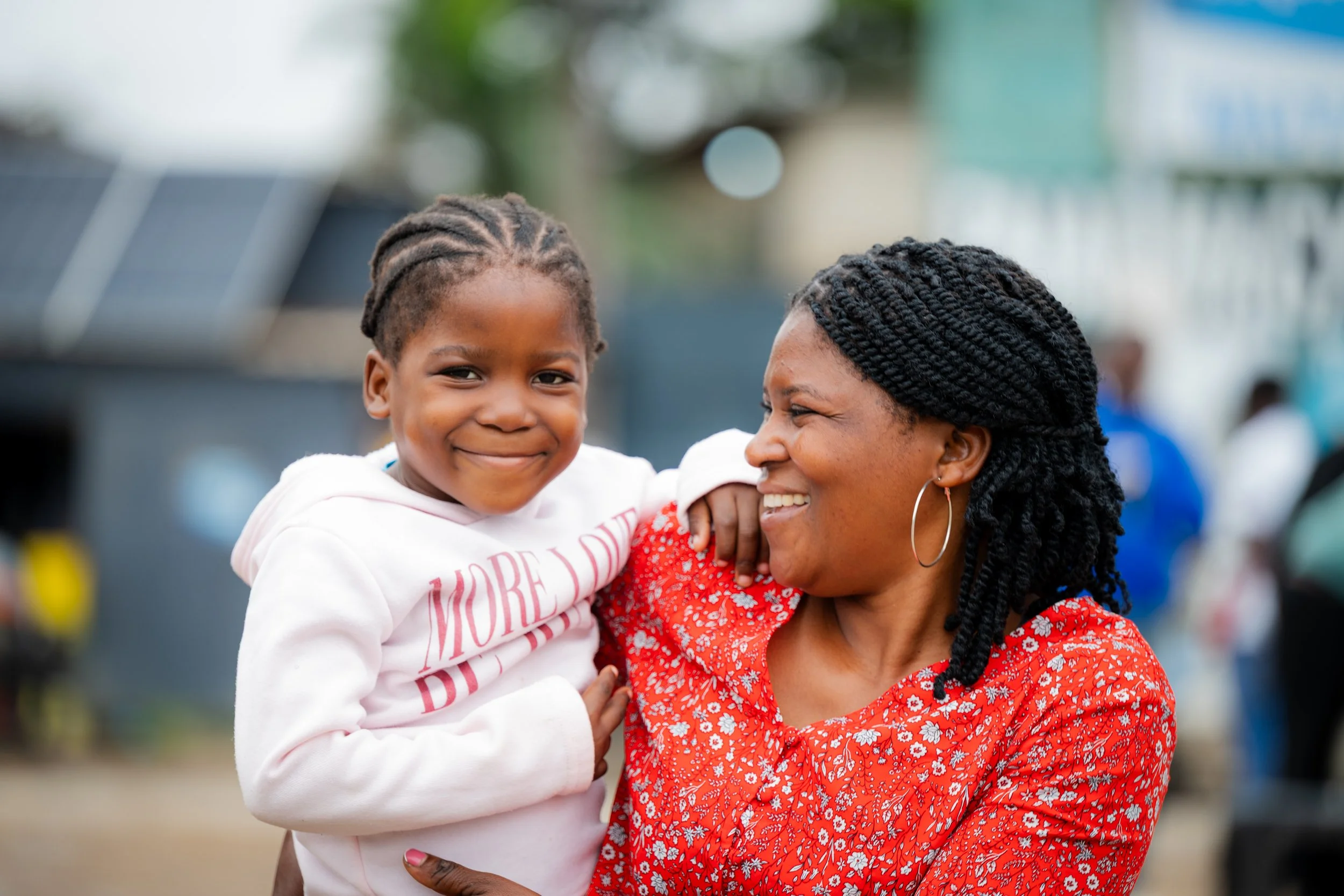
Margaret Nyirenda holds her five-year-old daughter, Isabella, outside the PEN-Plus clinic at Matero Level One Hospital in Lusaka, Zambia, in March 2026. Isabella receives ongoing care for sickle cell disease at the clinic. (Photo: Courtesy of the World Health Organization)
When her twin daughters were just five months old, Margaret Nyirenda noticed that one of them had a swollen finger. The following day, the other twin’s fingers began swelling, and soon both babies were screaming in pain. A nursing student, Nyirenda knew this was an emergency. She strapped one baby to her chest and the other to her back as she rushed the twins to the nearest clinic.
There a clinician diagnosed the twins with sickle cell disease and sent them to University Teaching Hospital in Lusaka, Zambia, where they were admitted in critical condition. With her husband out of the country, Nyirenda spent that first week camped out in a hospital corridor tending to two infants who needed transfusions, oxygen, and round-the-clock care.
The twins’ early years were marked by frequent hospital admissions and their parents’ constant fear.Advanced care for sickle cell was limited to the university hospital, and every crisis meant scrounging money for the trip.
Then, one evening in 2025, one of the twins, then four, fell suddenly and gravely ill. With no money, Nyirenda’s husband desperately sought transportation to urgent medical care. The little girl soon became unresponsive, though, and by the time the family reached the hospital, she was gone.
For Nyirenda, it was not only the death of a beloved child, but also the loss of a life that had been inseparable from her twin’s, even before birth.
Amid that grief, Isabella, the surviving twin, remained a source of hope for Nyirenda.
Later that year, Nyirenda and her husband were able to enroll Isabella in the PEN-Plus clinic at Matero Level One Hospital. With consistent care and proper medication, Isabella’s health began to stabilize.
Today, the child who needed intensive care early in life is an active and bright five-year-old. Curious about the world, Isabella has declared her intention to become a pilot. She also wants to be a doctor.
Nyirenda, meanwhile, carries both the weight of what she has lost and the hope of what remains. She has watched one daughter slip away without warning, and her training tells her exactly how little warning there was. She is grateful, she said, that the PEN-Plus clinic has given her a structure of care she can count on and a place where Isabella is known and monitored.
“She is not just surviving,” Nyirenda said of her daughter. “She is thriving.”