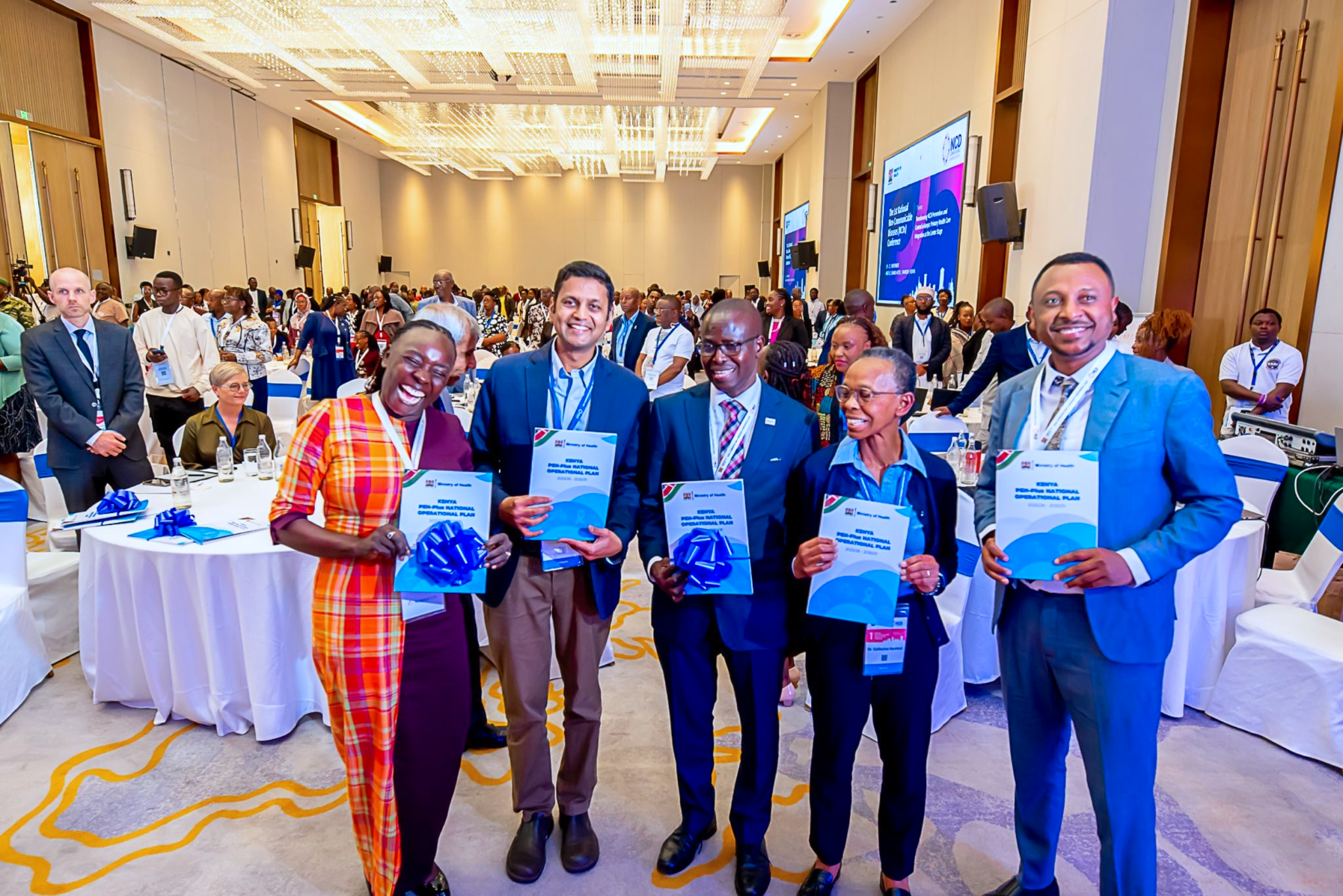
Participants in the event celebrating the launch of Kenya’s PEN-Plus National Operational Plan included, from left, Dr. Mary Amuyunzu-Nyamongo, board chairperson, NCD Alliance Kenya; Dr. Neil Gupta, senior director of policy, NCDI Poverty Network; Dr. Joseph Mogga, technical officer for NCDs and risk factors, World Health Organization; Dr. Catherine Karekezi, PEN-Plus implementer, NCD Alliance Kenya; and Dr. Natnael Abebe, regional advisor for East Africa, NCDI Poverty Network. (Photo: Courtesy of NCD Alliance Kenya)
When Dr. Yvette Kisaka recently presented on Kenya’s “three-year journey” to develop and mobilize support for its PEN-Plus National Operational Plan, one clear theme emerged: the proven track record of PEN-Plus in improving care for severe, chronic noncommunicable diseases in underserved areas.
During the NCDI Poverty Network’s Advocacy Working Group meeting in February, Dr. Kisaka, the technical lead for PEN-Plus, sickle cell disease, and cardiovascular diseases at the Kenya Ministry of Health, described the country’s process in formalizing the PEN-Plus plan and engaging stakeholders. Many of the key steps she listed—involving key partners, managing expectations, balancing competing priorities, and demonstrating financial stability—would be familiar to anyone who has sought to advance a large-scale project in government or the private sector.
Yet when it ultimately came down to selling the pitch, she said, the strategy focused on showing how PEN-Plus could solve problems, especially in Kenya’s counties, where local health decisions are made.
“PEN-Plus was, and still is, positioned as a solution to existing system gaps,” she said. “When you tell local health officials that PEN-Plus provides a solution for challenges with capacity-building of the health workforce, then it makes sense to them.
“Everyone wants to be part of a good story,” she continued. “A story that provides solutions.”
An Underpinning of Research
In 2020, the Lancet Commission on Reframing Noncommunicable Diseases and Injuries for the Poorest Billion estimated that interventions like PEN-Plus—a model for integrated care and a package of clinical services for people living with severe, chronic noncommunicable diseases (NCDs), such as type 1 diabetes, sickle cell disease, and childhood heart disease—could save 1.3 million young lives in sub-Saharan Africa and South Asia by 2030.
Several countries that have already implemented PEN-Plus are now launching national operational plans to detail how they will use the model to expand, integrate, and decentralize care for people living with NCDs. Kenya’s launch event took place in November 2025. Zimbabwe and Zambia also launched national PEN-Plus plans last year, while Ethiopia held its launch event in January 2026.
With additional countries preparing to launch plans later this year, Dr. Kisaka’s presentation was timely. She began by detailing the burden in Kenya, where research in the early phases of PEN-Plus initiation revealed that NCDs account for about 43 percent of mortalities and 50 percent of hospital admissions. Following that foundational work, in 2023, Kenya’s Ministry of Health piloted PEN-Plus in two counties, supported by the NCDI Poverty Network and implemented by NCD Alliance Kenya.

“We wanted to base our PEN-Plus National Operational Plan on evidence, data, and decision-making—but also to support evidence generation in the implementation of the plan itself.”
—Dr. Yvette Kisaka, Technical Lead for PEN-Plus, Sickle Cell Disease, and Cardiovascular Diseases, Kenya Ministry of Health
An initial step in building the national plan, Dr. Kisaka said, involved assessing existing policies in Kenya and studying the success of more advanced PEN-Plus countries, such as Malawi.
“I have to thank the Malawi team,” she said. “Their experience helped us develop a shared vision for Kenya and identify the direction we wanted to take our plan.”
Dr. Kisaka also noted that Kenya’s plan is simultaneously the result of previous research and a platform for supporting ongoing research.
“We wanted to base our PEN-Plus National Operational Plan on evidence, data, and decision-making—but also to support evidence generation in the implementation of the plan itself,” Dr. Kisaka said.
To scale up PEN-Plus nationally, Kenya’s plan calls for implementation in at least 20 counties, including the two pilot counties, by 2031, at an estimated annual cost of US$1.85 million.
Engagement of Key Stakeholders
With the shared goals and direction defined, the planners’ next step was identifying key stakeholders, both national and local.
“In Kenya, the Ministry of Health is in charge of developing policies, regulations, and technical support,” Dr. Kisaka said. “Service delivery in the health space, though, is done at the county level. Counties are responsible for clinical service and health workforce management, along with the procurement of health products and technologies.”
Each county has an NCD coordinator, Dr. Kisaka said, and they gather collectively as an NCD Caucus—a natural group to approach for support of the PEN-Plus national plan. In addition, Kenya has an NCD intersectoral coordinating committee, whose members Dr. Kisaka also involved in the plan.
Dr. Kisaka further invited participation from Kenya’s Ministry of Education, to address child health issues in schools, and ensured that PEN-Plus efforts aligned with the country’s long-term health system reforms, including those in health financing.
“You have to be explicit about why you bring each stakeholder on board, not just so they can feel valued, but also so you’re able to manage expectations when they come to the table,” Dr. Kisaka said. “There often can be competing mandates and priorities among the stakeholders.”
Given those potential conflicts, she said, it was important to frame Kenya’s PEN-Plus National Operational Plan as a shared obligation, rather than simply a Ministry of Health initiative. That approach helped education and finance officials, for example, view the extra work not as additional burdens, but as part of a larger, collective priority.
“I recommend anchoring support in government leadership—having the Ministry of Health at the table, leading the collaboration—so engagement can be prioritized throughout the government,” she said. “That gives you some legitimate power.”
“You can’t do this alone,” she added.
Learning Across Borders
Dr. Neil Gupta, senior director of policy for the NCDI Poverty Network, expressed his gratitude to Dr. Kisaka for her insights. He also noted that several countries—including Liberia, Mozambique, Sierra Leone, Tanzania, and Uganda—have PEN-Plus national operational plans in development, and Chhattisgarh State in India is preparing a regional plan.
“This progress represents not only valuable learning experiences for us and our country partners as they rise to their challenges, but also a huge inflection point for the Network,” Dr. Gupta said. “We’re excited about how we can help our partners bring their plans to fruition over the coming years.”