Scarcity of Data on Type 1 Diabetes Care in Low-Resource Settings Shows Need for PEN-Plus
Newly published study searched more than 16,500 studies and found just 46 with data relevant to rural areas of low- and lower-middle-income countries
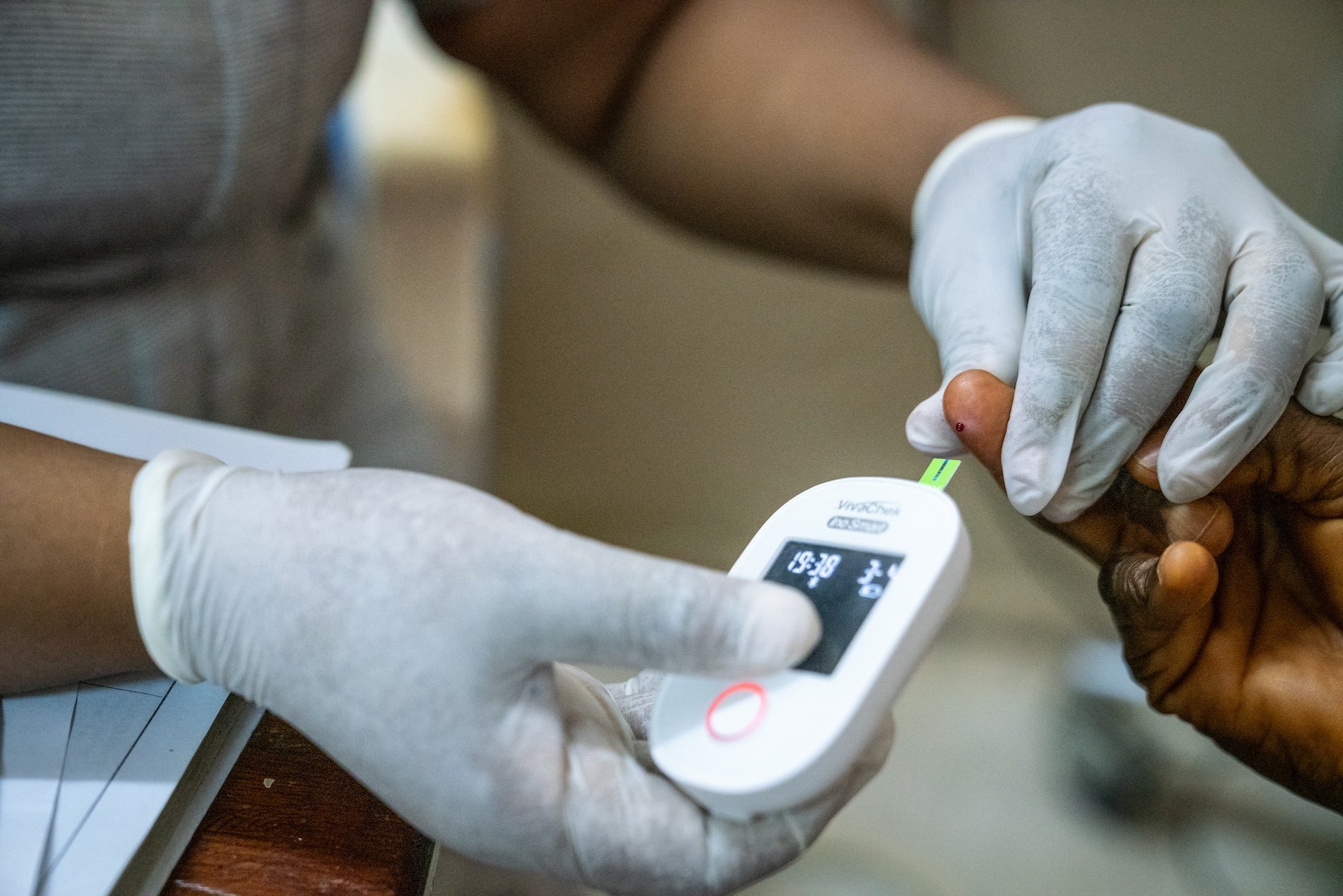
A patient living with type 1 diabetes has her glucose levels tested during a check-up at the PEN-Plus clinic at Koidu Government Hospital in Sierra Leone. (Photo: ©Michael Duff/World Health Organization)
A first-of-its-kind review of published studies on type 1 diabetes care found a significant lack of records and data in low-resource settings. These findings do more than suggest a wide gap in care for people living with the disease in rural areas of low- and lower-middle-income countries; they also underscore the urgent need to fill that gap.
The lack of care itself is, of course, well known. In rural sub-Saharan Africa and South Asia, regions home to 90 percent of the world’s poorest populations, most people living with type 1 diabetes and other severe, chronic, noncommunicable diseases must travel long distances to access essential health care services. Additional social determinants of health create significant, persistent barriers to accessing care.
Yet peer-reviewed documentation of that gap—and the related gap in quantifiable data showing the lack of care—has been scarce.
Quantifying and documenting those gaps are the goals of the study, “Decentralized chronic care service delivery for people living with type 1 diabetes in low- and lower-middle income countries: a scoping review,” led by the Center for Integration Science in Global Health Equity at Brigham and Women’s Hospital. The American Association of Clinical Endocrinology published the study in Endocrine Practice on March 26.
The study’s authors say their findings identify gaps in care that support implementation of PEN-Plus, a proven delivery model that integrates care for severe, chronic noncommunicable diseases. PEN-Plus clinics and health facilities provide care for several diseases that require similar clinical skills and can benefit from shared clinic space and information systems.
The authors also noted the timeliness of the findings in the current climate for global health. Severe, chronic noncommunicable diseases such as type 1 diabetes can have high rates of morbidity and mortality when poorly controlled, and so integrated models of care are especially important amid global health funding cuts. Treating multiple conditions under one roof can enable providers to leverage funds from multiple funding streams dedicated to different conditions, thus reducing inefficiencies and maximizing resources.
Only 46 Out of More Than 16,500
For the study, researchers at the Center for Integration Science—which serves, along with Universidade Eduardo Mondlane in Mozambique, as the NCDI Poverty Network co-secretariat—conducted a literature review of more than 16,500 journal articles published between Jan. 1, 2000, and May 20, 2024. The research team searched three electronic databases—PubMed, Embase, and Web of Science—and five regional databases from the World Health Organization, covering Africa, Southeast Asia, Latin America and the Caribbean, the Eastern Mediterranean, and the Western Pacific.
The researchers then narrowed those thousands of articles to the ones that addressed care for type 1 diabetes at first-level health facilities in rural, low-resource setting, which led to a pool of only 46 papers, which reported on 40 studies.
“Evidence from those studies indicated a lack of data, along with an urgent need to increase access to care, including priority supplies and treatment activities such as long-acting and fast-acting insulin regimes, and the ability to self-monitor glucose,” said Dr. Alma Adler, the Center’s director of research and a senior coauthor of the study.
Dr. Adler added that identifying inadequate care for type 1 diabetes in low-resource areas in sub-Saharan Africa shows the resulting need for integrated models of care that expand training and resources for providers in local, first-level hospitals and clinics to be able to provide care for people living with severe, chronic noncommunicable diseases.
“Because treating and managing type 1 diabetes is complex, we need stronger health care delivery systems in low- and lower-middle income countries,” Dr. Adler said. “Integrated systems can provide reliable access to medications, blood glucose monitoring, and high-quality education and support.”
The Case for PEN-Plus
The study’s coauthors wrote that their findings “demonstrate a need for a set of minimum standardized reporting for all programs, and highlight the urgency of scaling up at least intermediate type 1 diabetes care through global noncommunicable disease programs, including PEN-Plus.”
The PEN-Plus model decentralizes care from urban centers and capital cities, by expanding training and resources for clinicians at local hospitals and clinics in rural areas. PEN-Plus also promotes health education and peer support for children, adolescents, and young adults who live with noncommunicable diseases.
“There is a reason we are seeing more and more countries in sub-Saharan Africa and South Asia initiate, implement, and scale up PEN-Plus,” said Dr. Gene Bukhman, executive director of the Center for Integration Science and the other senior coauthor of the study. “That’s because it’s a proven, highly efficient, successful model of care that can streamline costs, broaden clinician training, and bring care to people who previously had no access.”
Fifteen countries across sub-Saharan Africa, South Asia, and the Caribbean are implementing the model. In 2022, all 47 member states of World Health Organization’s Regional Office for Africa adopted PEN-Plus as their official strategy for bringing lifesaving care closer to rural communities.
For young people with type 1 diabetes, PEN-Plus can provide a vital bridge to managing their condition and receiving vital support.
“PEN-Plus is about more than training clinicians and expanding resources,” Dr. Bukhman said. “Educating young people and families about their conditions, offering peer support programs and social support, and providing vital self-management equipment, such as home glucometers and glucose testing strips, empowers people not only to manage their condition, but also to thrive and live healthy lives, with success that starts in childhood.”